Book in progress
Memes vs. Genes
Ideas now evolve faster than the genes that carry the brains holding them, and they are selected by how far they spread, not by whether they are true. This book follows how that happened and what it is costing us.
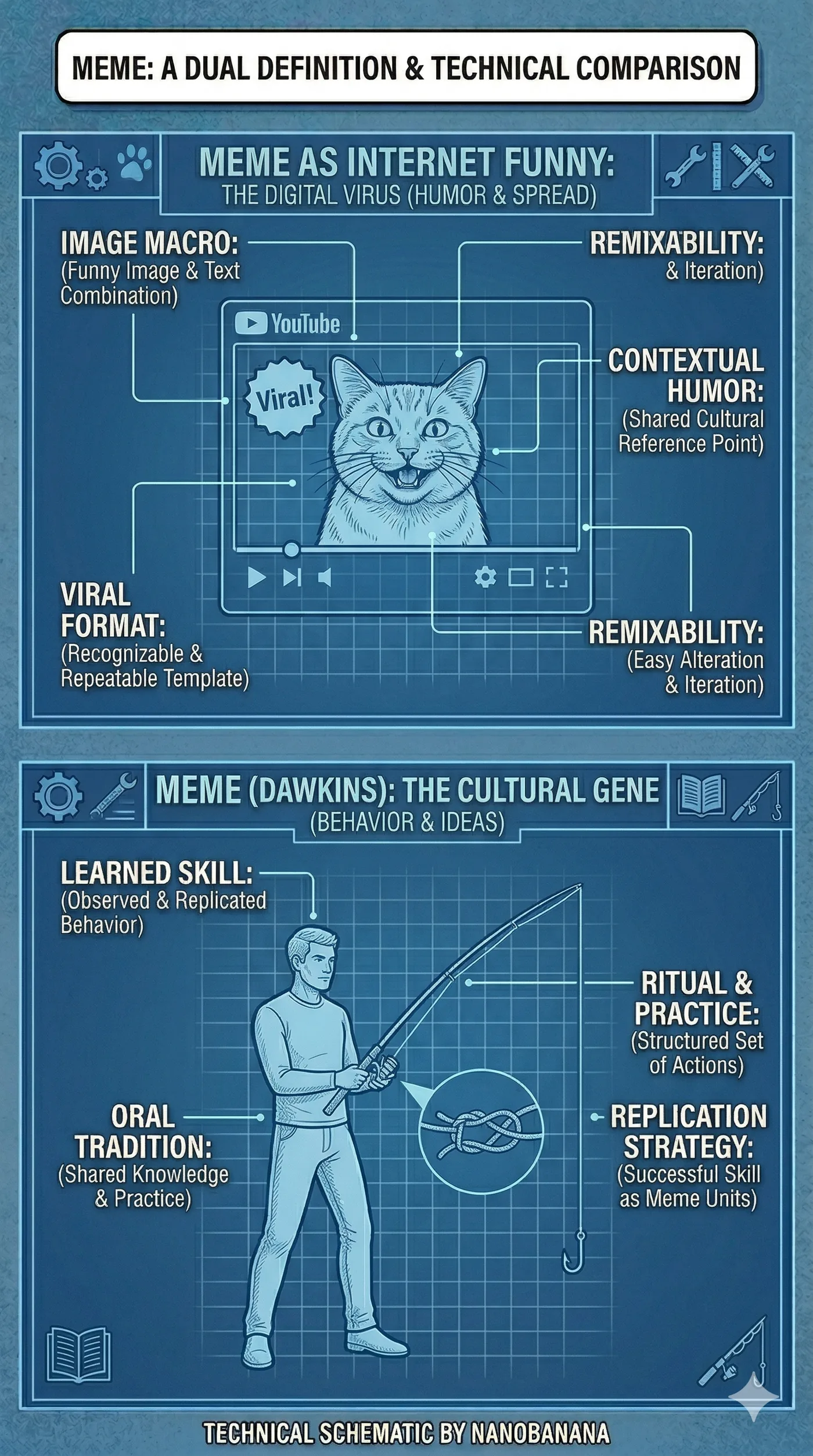
Two things are called a meme
In everyday use, a meme is an internet joke: an image with text, a recognisable format, funny because we share the reference, and easy for anyone to alter. It spreads because it is repeatable.
In Richard Dawkins’ sense, a meme is a unit of culture that replicates: a learned skill, a ritual, a practice, an oral tradition. It spreads because someone watched, copied and passed it on.
The book is about the second one, and about what happens when the machinery of the first one takes over how the second one is selected.
How ideas got out of our heads
The book follows one arc, and every step on it made ideas cheaper to copy and harder to kill.
On the savannah
Knowing how to make a tool was worth passing on. Teaching it gave a group an advantage over the ones that did not, and the brain that could hold and pass it grew.
Outside the body
Cave walls, clay tablets, papyrus. An idea stopped needing a living host and could wait, unchanged, for the next one.
The printing press
Copies became cheap and travelled. Ideas could now outlive the people who had them, by centuries.
Hard drives
Storage grew faster than anything before it. Ideas stopped competing for room in our heads and started competing for attention instead.
The reversal nobody planned
Once ideas evolved faster than genes, they began to steer the slower process. Medicine, farming and law are ideas, and they let people live and have children who would not have survived the selection that shaped us. Genes are now partly edited by memes, which is a stranger fact than it sounds.
The argument, in short
- On the savannah, a bad idea was culled with the people who held it. Today holding one costs nothing, so natural selection no longer edits our ideas.
- Writing, print and then hard drives let ideas live outside the brain, reproduce faster and survive their hosts.
- With attention scarce and shortened, ideas compete on virality, not on truth or usefulness.
- That is already reshaping democracy and the rule of law: a leader who entertains gets selected over one who governs well.
What the book asks for
Not a ban on anything. A field of study: how memes actually reproduce, and what it would take to align the way they are selected with outcomes that are good for the people carrying them. Right now the selection criterion is virality, and nobody chose it.
The book
Working title: The Replicator Wars: How Memes beat Genes. It is on its third draft, and it runs from the first replicator that built us to a testable version of memetics, the field that tried this once and did not survive contact with evidence.
Chapters go up here as they are written. The table of contents stays closed until the manuscript settles.